
What really holds AI face swap back, in four buckets
AI face swap is bounded by four kinds of limits: technical (angles, lighting, resolution), data and bias (distortion learned from training sets), ethical (misuse and missing safeguards), and legal (consent and likeness rights). The technical ones share a single root cause, the model predicts a plausible face rather than understanding a real one, which is why they ease as models improve. The ethical and legal ones are not engineering problems and will not be patched away. Knowing which is which tells you what to expect, what you can control, and where the responsibility sits with you, not the tool.
The four kinds of limitations, and why they are not the same
Most articles hand you a flat list of artifacts. That misses the point. A swap that warps on a head-turn and a swap that lands you in court are limitations of completely different kinds, and lumping them together hides which ones you can fix. Sorting them into four buckets makes the difference obvious.
- Technical: when the output looks wrong because the conditions or the input fought the model.
- Data and bias: distortions baked in before you ever pressed the button, learned from the dataset.
- Ethical: the harm the technology enables and the safeguards that real apps mostly skip.
- Legal: the line between a lawful edit and an illegal one, decided by consent and use, not by code.
One developer writeup puts it plainly: many of these are design challenges spanning technical, data, and ethical dimensions, not bugs waiting on a patch. The technical bucket has a tidy explanation underneath it. AI predicts outcomes rather than understanding faces. It maps landmarks and guesses a plausible result, so anything that makes the guess harder, a sharp angle, a shadow, a hand across the cheek, degrades the output for the same underlying reason. That is why the technical failures cluster instead of scattering.
Technical limitations: when and why the swap breaks
Accuracy is situational, not a fixed property of any tool. The same app produces a convincing frontal swap and a broken one the instant the subject turns away. Face swap is relatively easy on a frontal face and struggles with extreme poses, sharp turns, and non-frontal angles, because the model has less of what it was trained to read.
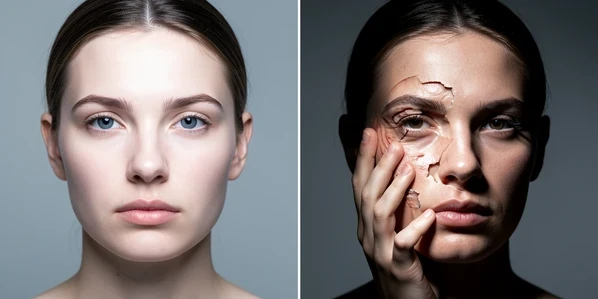
Lighting and resolution are the other two pressure points. Results hold up with consistent lighting and high-resolution sources, then fall apart under sudden lighting changes, occlusions, and low input quality, as the Dev.to breakdown of face swap algorithms and limits describes. Occlusions are the brutal ones: glasses, hands, hair, or a mask covering part of the face break the swap, because the model cannot map a landmark it cannot see. Feed it a low-resolution photo and you get pixelation, since there is no detail to reconstruct.
The artifacts themselves are predictable, and that predictability is the tell. Watch for these:
- Unnatural blinking, where the eyes open and close on the wrong rhythm.
- Facial warping during motion.
- A lighting and skin-tone mismatch between the face and the scene behind it.
- Loss of fine detail right where the eye looks first, around the eyes and mouth.
Each one traces back to the same fact. The model predicts the eyes, the mouth, the edges, rather than reconstructing them from a real face, so the regions that carry the most expression are the regions that fail first. Resolution and lighting are the two variables you can actually control. Fix those and most of this list shrinks.
Video, real-time, and the compute wall
A still photo needs one good frame. Video needs every frame to agree with the last, and that is a harder problem. Temporal consistency is where it shows: the face is regenerated frame by frame, small differences accumulate, and you get flicker and warping across a clip that looked fine as a single image.
Live swapping adds a hard deadline on top. Real-time face swapping strains even powerful systems and degrades on high-resolution video or fast-moving subjects, the AiTude analysis of video face swap accuracy notes, because the model now has to produce each frame within a fixed compute budget. Push the resolution up or speed the subject up and quality drops to keep pace. Some tools sidestep this entirely and simply do not support real-time or live swaps.
Further out sits an even rougher edge. Generating facial expressions and head movements from an audio track, driving a portrait from speech, is still a research-stage capability with many limitations. It is not a feature you can lean on yet.
Data and bias limitations
Some limits are baked in before runtime. Deep learning models learn facial alignment from datasets and then predict it, so when your input drifts from what they saw most, variations in lighting, expression, or angle, the prediction skews and the swap distorts. This is the same mechanism the People Also Ask answers point at, just stated honestly: the model is guessing alignment from prior examples, not measuring your actual face.
Bias is the sharp edge of this. When a dataset underrepresents certain faces, those faces get the worst results: skin-tone mismatch and distortion that lighter, more-represented faces rarely see. It is not the tool singling anyone out. It is the training data showing through.
Which is why the demos lie a little. Viral face swap clips use cherry-picked inputs, dodge the edge cases, and get a light editing pass before posting. Your everyday photo gets none of that, so your output is more inconsistent than the highlight reel implies. The gap between the marketing and the median result is itself a practical limitation.
Ethical limitations and the safety-guardrail gap
Past the rendering problems, the technology is bounded by what people do with it and by how little stands in their way. The malicious uses are concrete: cyberbullying and harassment, blackmail and extortion, impersonation and identity fraud, and non-consensual pornography. These are not hypotheticals attached to a niche tool. They are the documented misuse patterns.
The uncomfortable part is how rarely apps push back. A peer-reviewed audit downloaded 420 face swap apps and manually tested 155 eligible ones, and the numbers are stark. Per that arxiv study:
- 70% of the tested apps have no technical safeguard against generating nude images.
- On the Apple App Store 80% allowed nude face swaps without restriction; on Google Play it was 59%.
- 68.3% of the apps bundled other deepfake tools, like image-to-video and voice synthesis, in the same package.
Apple and Google have started pulling nudification apps. But the same audit found that dual-use face swap apps with the identical underlying capability stay up, because their listed purpose is ordinary face swapping. Remove the apps that say the quiet part out loud and the ones that can do the same thing remain a tap away. The percentages describe the ecosystem, not any single tool, so a specific app may be cleaner or worse than the average. Underneath all of it sits one boundary: consent. Without it, even a technically flawless swap is an ethical failure.
Legal limitations: where use crosses the line
The technology itself is not inherently illegal. Legality hinges on a short list of facts: whose face it is, whether they consented, the nature of the content, the purpose, and how far you distribute it. A legal explainer on face swap framing makes the same point, and it reframes the whole legal question away from the tool and toward the act.
Two lines matter most. Creating or distributing sexually explicit swaps of someone without their consent is illegal in a growing number of jurisdictions, and the trend is toward more, not fewer, such laws. Separately, many jurisdictions recognize a right of publicity, or personality rights, protecting a person's control over the commercial use of their likeness, so a swap built into an ad or a paid promotion can be unlawful even when nothing about it is explicit.
Obtaining explicit, informed consent from the person whose face you are using is the single most important step to mitigate legal risk.
Note the durability problem. "Legal where I am today" is not a stable position when the law is actively shifting toward criminalizing non-consensual explicit swaps. Consent travels better than jurisdiction does.
Which limits will improve and which are here to stay
Here the four-bucket split pays off, because the buckets have different futures. Technical limits are softening. Diffusion models are an emerging alternative to the older GAN approach: they denoise a masked target conditioned on the source face, which matches lighting, angle, and expression more closely than GANs managed. Expect the warping, the lighting mismatch, and the angle failures to keep receding as this matures.
The ethical and legal limits are a different animal. No model upgrade resolves a consent violation or a harassment case. Better rendering makes a non-consensual swap more convincing, which makes the harm worse, not smaller. These are boundaries on use, not on capability, and they do not yield to engineering.
So control what you can. For the technical failures, the levers are in your hands before you upload: pick a front-facing source, light it evenly, and start from the highest resolution you have. That one habit removes most of the artifacts in this article. For everything past the render, the rule is simpler still. Get consent, and the hardest limits stop being your problem to argue.