
What law covers a deepfake of a celebrity, harm by harm
Short answer: is it illegal to make or post a deepfake of a celebrity?
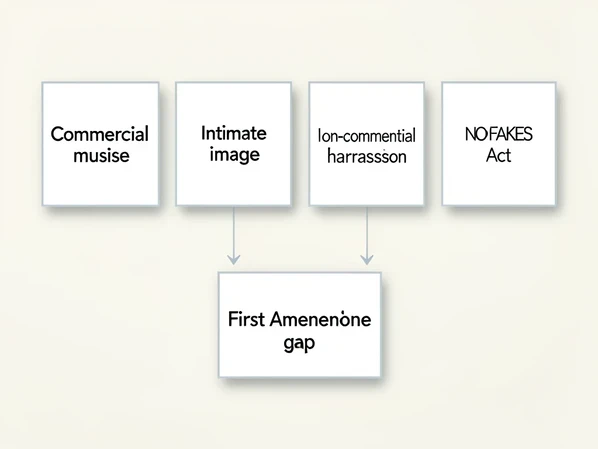
It depends on what the deepfake does, not on the act of making it. No single statute bans deepfakes outright. Instead, a handful of separate legal tools each cover one kind of harm, and whether you have a claim turns on how the image is used. Put a celebrity in a fake ad and you are in right of publicity territory. Post a fabricated intimate image and a dedicated federal law applies. Mock a public figure in a non-commercial parody and you may run straight into the First Amendment.
Two distinctions decide almost everything. First, making versus publishing: creating a deepfake on your own device rarely triggers liability, while sharing, posting, or selling it usually does. Second, commercial versus non-commercial use is the main dividing line for the most common remedy. The rest of this page is a harm-to-remedy map. Each section takes one type of harm and names the exact legal mechanism that covers it, then shows where that mechanism stops.
Right of publicity: the main tool celebrities use
Right of publicity gives a person control over the commercial exploitation of their identity: their name, their likeness, and their voice. It is the workhorse for celebrity deepfake disputes because so many of them are about money, an unauthorized endorsement, a fake ad, a product wrapped in a famous face.
California codifies it in Civil Code section 3344, which prohibits using another person's name, voice, photograph, or likeness on products or in advertising without prior consent. According to Bloomberg Law, California's statute is one of the most comprehensive in the country. And here is the part that surprises people: the California statute does not necessarily require the plaintiff to be a celebrity or to prove their identity has commercial value. The protection attaches to the person, famous or not.
California has since sharpened the rules for synthetic media. AB 2602 and AB 1836 require explicit consent before a performer's digital likeness can be used and mandate clear marking on work that contains AI-generated replicas. The direction of travel is plain: consent first, and label the fake.
The state-by-state patchwork (and the Reface lawsuit)
In the United States, right of publicity is governed state by state, which is exactly why the same deepfake can be clearly illegal in one place and a gray area next door. California and New York offer the clearest statutory guidance. Many other states leave the boundaries undefined. Roughly 35 states recognize the right at all, whether through statute or case law, per the Michigan Technology Law Review.
Live litigation shows the stakes. In Young v. NeoCortext (2:23-cv-02486), filed April 2023, 'Big Brother' finalist Kyland Young sued the maker of the Reface face-swap app under California's right of publicity, arguing the app commercialized his likeness without consent. The case is a direct test of whether a consumer face-swap product can be held to the same standard as an advertiser. The Honigman analysis treats it as a bellwether for how publicity law adapts to apps.
New York pushes into territory most states ignore: the dead. New York Civil Rights Law section 50-F, effective 2021, bars the unauthorized use of a deceased performer's digital replica in scripted audiovisual works. It carves out an exception when a clear disclaimer is attached. Postmortem coverage like this varies sharply from state to state, so where a person lived and died can matter as much as where the deepfake was posted.
Where right of publicity stops: the First Amendment and non-commercial harm
Right of publicity claims usually require commercial use. That single requirement opens a real void. A deepfake made to harass, humiliate, or damage a reputation, with no product or ad attached, often falls outside the right of publicity entirely. Victims are routinely shocked to learn that the most personal attacks can be the hardest to pursue under this particular tool.
The First Amendment widens the gap. Transformative use is a recognized defense: when content is treated as parody, satire, or commentary, it can be protected expression even if the subject is harmed by it. Courts weigh whether the work adds something new and expressive rather than simply trading on the person's identity.
There is also a definitional wrinkle. Some apps only mash up faces, splicing one face onto a clip, rather than making a person appear to say or do specific things. Experts may not classify that as a true deepfake at all, which further muddies whether any single legal tool cleanly applies.
Intimate deepfakes: the TAKE IT DOWN Act
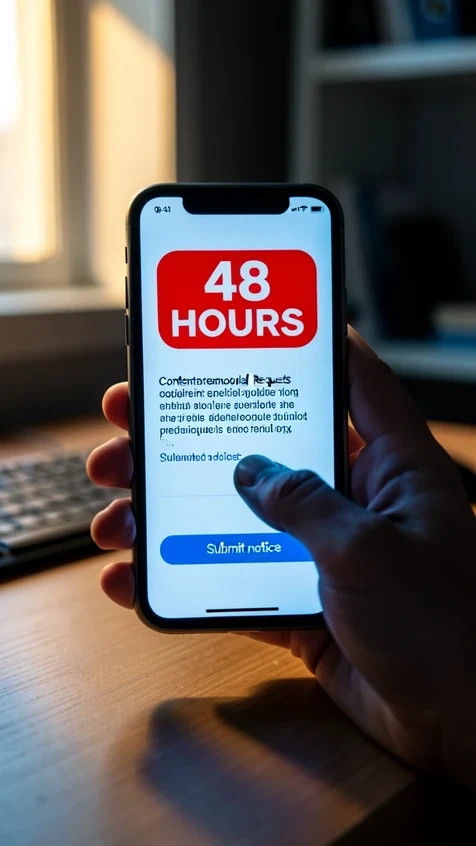
Fabricated intimate imagery gets its own dedicated federal law, and it does not depend on commercial use or fame. The TAKE IT DOWN Act criminalizes the knowing publication of intimate images, including AI-generated ones, and forces platforms to remove a flagged image within 48 hours of a victim's notice. That 48-hour clock, reported by Lawfare, is the concrete remedy victims of other harm types often lack.
Why does this harm get a tailored statute when others do not? The numbers. Around 98% of deepfake videos are explicit, and most target women, according to data summarized by Korejzova Legal. A harm that overwhelmingly hits one group, with speed and at scale, drew a focused response rather than a stretched application of older law.
Trademark and copyright: what they can and cannot do
Start with the misconception that trips up almost everyone: copyright does not protect your face or your voice. It protects creative works. A deepfake only raises a copyright issue if it copies a specific copyrighted work you happen to appear in, a film, a photo, a recording, not your identity in the abstract. And copyright law goes a step further the wrong way for victims. Section 114(b) of the Copyright Act permits independently recorded sound-alike recordings, so imitating a recorded performance is not, by itself, infringement.
Trademark is the more useful intellectual-property route, but it is proactive, not reactive. It only helps a persona that registered marks in advance. Matthew McConaughey did exactly that, filing in 2024 to secure eight federal trademarks on his name, image, and the catchphrase 'Alright, alright, alright' specifically to fight AI misuse of his likeness. Registered marks support false-endorsement claims, the argument that the public might wrongly believe the person sponsors or approves a product.
Even the government concedes the gaps. On July 31, 2024, the U.S. Copyright Office released a report concluding that existing law offers little protection against deepfakes and that new federal legislation is needed. When the office charged with administering copyright says copyright is not the answer, the message is hard to miss.
A federal fix on the horizon: the NO FAKES Act
The proposed answer to the patchwork is the NO FAKES Act, introduced in July 2024 and reintroduced in April 2025. It would create a national digital replication right protecting both voice and visual likeness from unauthorized AI recreations, a single federal standard instead of 50 different ones. If enacted, it would give ordinary people and celebrities alike a consistent claim no matter which state they live in.
Performers have been pushing this for years. Back in 2020, SAG-AFTRA lobbied for the New York legislation that expanded the state's right of publicity to cover digital replicas of deceased celebrities and deepfake pornography. The union's fingerprints are on both the state-level wins and the federal proposal now in play.
Outside the U.S.: UK, Canada, and the EU
Cross a border and the toolkit changes entirely. The UK does not recognize a standalone image right, so protection is assembled from a patchwork of trade marks, passing off, copyright, data protection, confidentiality, and contract. A passing-off claim there has to show three things: goodwill, misrepresentation, and damage. Canada uses a different tort, and the EU starts from a broader baseline.
| Jurisdiction | Main legal tool | Key requirement |
|---|---|---|
| United States (California) | Right of publicity, Civil Code 3344 | Consent for commercial use; celebrity status not required |
| United Kingdom | Passing off, plus trade marks and data protection | Goodwill, misrepresentation, and damage; no standalone image right |
| Canada | Misappropriation of personality | Subject clearly identifiable and exploited for a commercial purpose |
| European Union | Right to one's own image | Broader protection than U.S. law, notably on social media |
Canada's misappropriation-of-personality tort, as Gowling WLG explains, requires that the subject be clearly identifiable and that the use serve a commercial purpose, an echo of the U.S. commercial-use hurdle. The EU's right to one's own image is the broadest of the four and bites harder on social-media reposting. So a single deepfake can be actionable under Civil Code 3344 in California, fought as passing off in London, framed as misappropriation in Toronto, and clearly barred in much of the EU.
If you are not a celebrity
The assumption that only A-list stars need to worry is wrong, and dangerously so. Founders, executives, influencers, creators, models, and entirely private individuals are all targets. California's right of publicity, as noted earlier, does not require celebrity status, so an unauthorized commercial deepfake of an unknown person is still actionable there.
For the most damaging non-commercial harm, fame is irrelevant by design. Intimate-image victims can invoke the TAKE IT DOWN Act regardless of whether anyone knows their name, with the same 48-hour platform removal that a celebrity would get. The remedy follows the harm, not the headcount of your followers.
Money and fraud sharpen the point. In one 2024 case, fraudsters impersonated a CEO's face and voice on a video call and walked away with $25 million. Nearly 37% of fraud investigators say they have already run into voice deepfakes on the job. Those are not celebrity stories. They are business and personal-security stories, and they are the reason a federal standard like the NO FAKES Act keeps gaining ground.