
Deepfakes at the movies: what is real, what is CGI, and what got mislabeled
Yes, deepfakes and digital face replacement turn up in real films. But far less than the headlines suggest. The technique has seen limited uptake in Hollywood, and CGI remains the industry's preferred visual effect for almost every big swing. So the honest answer is a qualified yes, with an asterisk most articles skip.
That asterisk matters. Half the scenes people confidently call deepfakes were never deepfakes at all. The rest of this piece is a film-by-film ledger that sorts each famous example into the right bucket: true neural-network deepfake, digital face replacement, or plain old CGI.
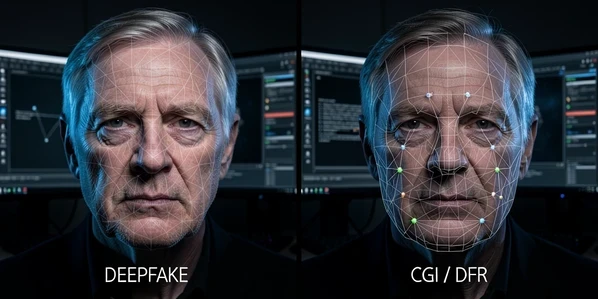
Deepfake or CGI? The line most people miss
A deepfake is synthetic media made by a trained neural network, usually a generative adversarial network, that learns one face or voice from many samples and grafts it onto another performance. The machine does the heavy lifting. Nobody sculpts the result frame by frame.
Digital face replacement, or DFR, is the older path. Here a VFX team builds a face by hand, matches it shot by shot, and renders it with conventional CGI. The output can look identical to a deepfake on screen. Under the hood it is a different craft entirely: hand-built geometry versus a learned model.
Hold onto that distinction. It is the whole reason the next two sections disagree with what you have probably read.
Films that genuinely used face-swap or replacement tech
Start with the clearest case. For The Mandalorian, Disney Research Studios developed production-ready face re-aging that recreated a younger Luke Skywalker over Mark Hamill, per defake.app. This is the closest a major production has come to deploying a deepfake-style learned method at scale, and it set the modern benchmark.
Other landmark scenes lean on a mix of techniques, and the labels get blurry fast. Rogue One brought back Peter Cushing as Grand Moff Tarkin by placing the late actor's head on body double Guy Henry, the BFI reports, while Carrie Fisher's younger Leia was rebuilt through a blend of AI and visual-effects work. The Irishman de-aged Robert De Niro and Al Pacino across the whole runtime. Fast and Furious 7 finished Paul Walker's scenes after his death, casting his brothers Cody and Caleb as doubles and mapping his face onto theirs.
Voice belongs in this story too. After Val Kilmer lost his voice to throat cancer in 2015, Sonantic's technology rebuilt a synthetic version of it, according to WIPO Magazine. And in 2024, The Brutalist used AI to fine-tune its actors' accents, which set off a loud argument about artistic integrity. Different tools, different goals, same underlying shift toward synthetic media.
| Film | Scene | What it actually was |
|---|---|---|
| The Mandalorian | Young Luke Skywalker | Neural face re-aging (closest to a true deepfake) |
| Gemini Man | Young Will Smith clone | Built digital human, called the most believable by IndieWire |
| Rogue One | Grand Moff Tarkin | Digital face replacement, conventional CGI |
| Rogue One | Young Princess Leia | Blend of AI and VFX techniques |
| The Irishman | De-aged De Niro and Pacino | Largely traditional CGI |
| Fast and Furious 7 | Paul Walker's final scenes | CGI face mapping over his brothers |
| Val Kilmer (Top Gun: Maverick era) | Synthetic voice | AI voice cloning via Sonantic |
| The Brutalist | Accent adjustment | AI voice editing |
Gemini Man earns its row. Its de-aged Will Smith was called the industry's most believable digital human by IndieWire. A digital human, note, not a deepfake in the strict sense.
The scenes everyone calls deepfakes (but were not)
Two of the most cited examples are misfiled. The famous de-aging and resurrection moments in The Irishman and Rogue One's Tarkin were largely achieved with traditional, labor-intensive CGI, not deepfakes, defake.app notes. Tarkin in particular was a painstaking digital face replacement done at enormous cost, frame by frame, by a team of artists. No learned model swapped that face.
So why does almost everyone get this wrong? Because the press and the public reach for one word. Any time a dead actor returns or a star sheds twenty years, it gets called a deepfake, regardless of the method underneath. The label is sticky. The truth is duller and more expensive.
Here is the twist that makes the point land. After The Mandalorian aired, a fan known as Shamook posted an improved deepfake of young Luke that many viewers judged sharper than the studio's own shot. Lucasfilm's ILM then hired him. A bedroom technique briefly outran a billion-dollar pipeline, which tells you the gap is closing even if studios have not switched over.
Why studios keep reaching for CGI anyway
Deepfakes are, in principle, cheaper and faster than building a face by hand. Yet despite their transformative effects, deepfakes have seen limited uptake in Hollywood, where CGI remains the preferred visual effect, per a University of Oklahoma analysis. The gap between principle and practice is the interesting part.
It comes down to control. A CGI pipeline lets supervisors adjust a single eyebrow, relight a face for a new shot, or fix one bad frame without retraining anything. Learned models are harder to steer when a director wants a precise change. For a marquee scene that will be paused, screenshotted, and dissected by millions, studios still trust the method they can fully command.
- Fidelity at scale: CGI holds up under 4K scrutiny on a cinema screen, where small deepfake artifacts get magnified.
- Pipeline fit: existing VFX houses are already built around hand-crafted geometry, not model training.
- Predictability matters more than raw speed when one flawed frame can derail a release.
Bringing actors back: consent, estates, and legacy
Resurrecting a performer is not just a technical feat. It is a permissions problem. Posthumous use of an actor's likeness requires consent from estates or families, which complicates every negotiation, defake.app notes. Get that wrong and you are not making a tribute, you are making a lawsuit.
The flashpoint was Finding Jack, a Vietnam-era drama that planned to cast James Dean, who died in 1955. The backlash was immediate and loud. Many actors and fans saw it as using a person who could never agree to the role, and the project became shorthand for the whole debate over digital revival.
The business has started naming the thing. WIPO Magazine frames deepfake wrappers and deepfake actors as a new category inside talent agreements, where likeness rights get negotiated like any other asset. Expect those clauses to grow as the tools improve and the next James Dean situation arrives.
The viral deepfakes that shape how you watch movies
Your instinct to yell deepfake at the screen was trained outside the cinema. The viral Tom Cruise TikToks did most of that work. Impersonator Miles Fisher performed the body and voice, director Chris Ume swapped Cruise's face on top, and the clips pulled in 11 million views, the BFI reports. Millions learned what a flawless face-swap looks like from a comedy account, then carried that expectation into every movie they watched.
The origin is darker than the meme. Deepfakes first surfaced in 2017 when a Reddit user swapped celebrities' faces into pornographic clips. That non-consensual root still colors how the public hears the word, which is part of why studios stay cautious about the label.
Deepfakes are not always a scandal. The same technique let David Beckham deliver a Malaria No More message in nine languages, a campaign use that was fully consented and aimed at saving lives, per WIPO Magazine.
Do movie deepfakes rewrite our memories?
A peer-reviewed study put the worry to the test. Researchers showed 436 participants deepfake videos of fictitious movie remakes and recorded a 49% average false memory rate, published in PMC. Roughly half the viewers came away remembering a remake that does not exist. That number is genuinely unsettling.
But read the caveat that almost no coverage quotes. In the same study, deepfakes were no more effective than simple text descriptions at distorting memory. A paragraph of writing planted false memories just as well as a slick fake video. So the danger is suggestion itself, not the deepfake's polish, and that reframes the panic considerably.