
AI Face Swap Explained: The Pipeline, the Models, and the Tells
AI face swap replaces one person's facial identity onto another person's body or video frame through a deep learning pipeline. It is not a filter. It is not a sticker. The system detects a face, maps its geometry, synthesizes a new image that matches the target's lighting and skin, then cleans up the seams. Three model families sit under the hood: generative adversarial networks, autoencoders, and StyleGAN style blending. Each produces a different balance of realism, speed, and identity accuracy. This explainer walks through the mechanism step by step, shows why swaps fail, and ends with a checklist for spotting one.
What Is AI Face Swap? (And Why It Is Nothing Like a Filter)
A Snapchat filter draws dog ears on top of your face. A cut-and-paste in Photoshop drops one face onto another and hopes the lighting cooperates. AI face swap does neither. It replaces a person's facial identity onto a different body or frame using deep neural networks that understand 3D facial geometry, lighting physics, and temporal consistency across video.
The output is synthesized, not pasted. Every pixel inside the swapped region is generated fresh by a model that has learned what a face looks like under the exact lighting, angle, and skin conditions of the target frame. Filmora's engineering team describes this as a sophisticated multi-step process, drawing a sharp line between modern swaps and the 2D overlay tools of a decade ago.
The word deepfake was coined in 2017, right when GANs became publicly accessible and hyper-realistic face swaps reached the internet. People often use the two terms as synonyms. They should not. Both rely on the same neural architectures, yet deepfake carries a connotation of deception or harm, while AI face swap tools built by companies like Higgsfield AI and Pica AI explicitly prohibit non-consensual use in their policies. Same math, very different intent.
The Four-Step Pipeline: How AI Swaps a Face
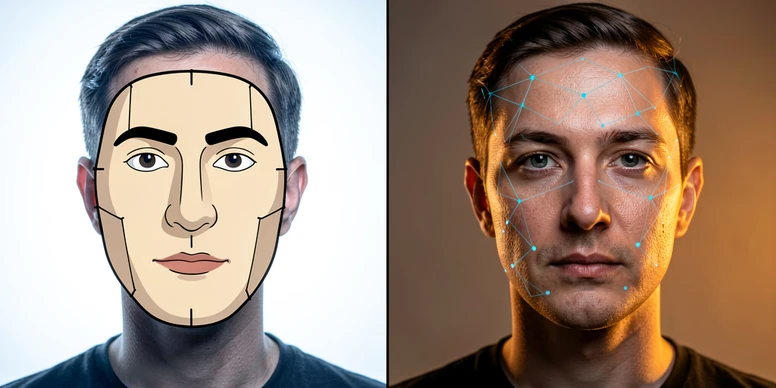
Between clicking upload and downloading a result, the software runs four distinct stages. Piktid's breakdown of the processing sequence maps neatly onto what nearly every modern tool does internally, and it is the cleanest mental model for a curious reader.
Step 1. Facial detection and analysis
First, the model has to find a face. A detector scans the image or each video frame, draws a bounding box around the facial region, and estimates the pose angle. If there are two faces in the shot, the model has to decide which one to operate on. Miss this step, and nothing downstream has anything to work with.
Step 2. Facial landmark detection
Next, the system plants reference points across the face. Eyes, nose, mouth corners, chin line, jaw curvature. Akool's documentation notes that convolutional neural networks are the workhorse here, identifying and mapping these landmarks so the source and target geometries can be aligned. Typical systems use 68 to 128 points. This alignment step is the foundation of the whole swap. Bad landmarks produce a crooked mouth or misaligned eyes no amount of later blending can fix.
Step 3. Feature mapping and image synthesis
Now the model generates the new face. It takes the learned facial identity from the source and renders it in the target's pose, lighting, and expression. Skin tone is rebalanced, shadows are redrawn, texture is resampled so the new face sits inside the scene rather than on top of it. This is where most of the computational weight lives and where the choice of architecture (GAN, autoencoder, or StyleGAN) shapes the final quality.
Step 4. Post-processing
The last pass fixes what the synthesis step missed. Edge blending smooths the boundary where new pixels meet the original body and hair. Color correction nudges skin tone if it drifted warm or cool. Temporal smoothing, on video, reduces flicker across consecutive frames. Done well, this stage is invisible. Done poorly, it is the reason you can see a faint halo around a swapped jawline.
Three Architectures Behind the Magic: GANs, Autoencoders, and Style Blending
The four-step pipeline is the skeleton. The model doing the synthesis in step 3 is the muscle. Three architectures dominate the field, and most competitor explainers stop at naming one. Here is how all three actually work.
Generative adversarial networks
Picture a forger and an art detective locked in a room. The forger paints a fake Vermeer and slides it under the door. The detective inspects it, spots the mistake, tosses it back. The forger tries again. Do this a few million times and the forger gets very, very good.
That is a generative adversarial network. Two neural networks train against each other. Filmora's explainer describes the pairing cleanly: a generator produces synthetic faces, a discriminator evaluates whether each one looks real, and both improve through iterative feedback. After enough rounds the generator's output is indistinguishable from a real photograph to the discriminator, and often to humans.
Autoencoders
Autoencoders compress a face into a short numeric representation and then rebuild it. Filmora describes the trick that enables face swap: train a shared encoder on both the source and target faces, then use separate decoders for each identity. Feed a target-face image into the shared encoder, decode it with the source-face decoder, and the model reconstructs the target's pose and expression wearing the source's identity. Fast, relatively lightweight, but fine texture detail can get lost in the compression.
StyleGAN style blending
The newest family works in StyleGAN's latent space. Faces are represented as style codes, vectors of numbers that encode attributes like eye shape, skin texture, and bone structure. A Lancaster University research summary (published on Medium) describes the Style Blending Module (SBM) using an attention mechanism to focus on the relevant parts of those codes and enforcing constraints such as facial landmark alignment and dual swap consistency, meaning the swap has to be coherent when reversed. Architecturally complex. Best identity preservation of the three.
| Architecture | Core idea | Strength | Trade-off |
|---|---|---|---|
| GAN | Generator vs. discriminator loop | High realism, strong texture | Heavy compute, can hallucinate detail |
| Autoencoder | Shared encoder, separate decoders | Fast, stable on varied poses | Loses fine texture detail |
| StyleGAN / SBM | Blending style codes in latent space | Best identity preservation | Architecturally complex |
What Makes a Face Swap Look Real or Fake
Why does your friend's swap look convincing and yours looks like a sticker? Five factors decide, and each one maps to a specific step in the pipeline that can break.
Identity preservation
Viggle AI's guidance on safe swapping spells it out: the system has to hold facial proportions, feature placement (eye spacing, nose position, mouth alignment), skin characteristics, and overall likeness consistent across every frame. Any drift between frame 12 and frame 47 is immediately visible to a viewer even if they cannot name what shifted. This is why the StyleGAN style-blending approach, with its explicit identity constraints, tends to outperform autoencoders on longer video clips.
Expression transfer
The number one reason swaps look stiff. Viggle AI's blog names expression transfer as the primary culprit behind uncanny results: the swapped face has to replicate the target's mouth movements, blinks, gaze direction, and subtle muscle micro-movements frame by frame. Consider a smile in frame 47. The original actor raises their zygomatic muscle, the corners of the mouth pull up, the cheeks round, the eyes narrow slightly. The swap must reproduce every one of those micro-movements with the source identity's geometry, or the face reads as a static grin glued onto a moving head. Most consumer tools handle basic smiles. Subtle emotions like restrained anger or tired amusement are where they still fall down.
Lighting coherence and skin tone blending
Imagine a source photo taken under warm indoor tungsten light swapped onto a target shot outdoors at dusk with cool blue shadows. Without correction the swapped face looks like it is floating. The synthesis step is supposed to re-render the source identity under the target's lighting, relighting shadows on the nose bridge, matching cheek highlights, and rebalancing skin tone. When this fails, the face is technically the right shape but visually wrong in a way viewers sense before they can explain.
Edge artifacts
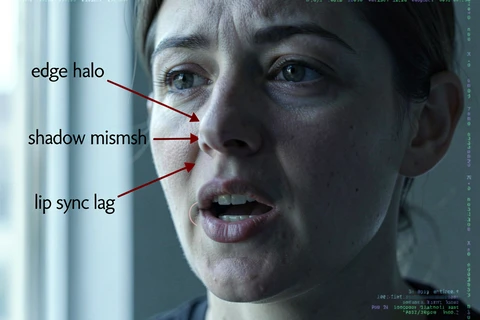
That faint halo around a swapped jawline is a post-processing failure. The model generated new pixels inside a face-shaped region, but the boundary blending did not fully match texture and color with the surrounding hair, ears, or neck. On still photos it looks like a bad cutout. On video it shimmers.
The deepfake detection checklist
Magicshot's rundown of detection cues doubles as a field guide you can run through in about ten seconds when you watch a suspicious video:
- Blinking rate. Humans blink roughly every 4 to 6 seconds. Too often, too rarely, or asymmetric blinks are a red flag.
- Shadows that do not match the light direction on the rest of the scene.
- A slight halo, blur, or double-edge around the jawline, hairline, or ears.
- Skin tone that shifts between the face and the neck.
- Audio-lip sync lag, especially on plosive consonants like P and B.
- Unusual facial movements during speech, such as a mouth that opens without the jaw moving.
One more data point worth knowing. Filmora notes that real-time face swap is no longer a research demo. Optimized inference algorithms let swaps run live on video calls and streams, a capability that was computationally out of reach just a few years back. Realistically, live swaps trade quality for speed, so the artifacts above show up more aggressively in real-time output than in offline renders.
Legitimate Uses: Beyond Memes and Social Media
Face swap started on Reddit as a novelty and TikTok as entertainment, so most people still think of it as a meme engine. The professional use cases tell a different story.
- Film VFX. The BCcampus Pressbooks overview documents de-aging actors across decades, bringing historical figures to life on screen, and letting a single actor portray multiple roles without heavy prosthetics.
- Documentary anonymization. Magicshot describes a technique already standard in sensitive journalism: a whistleblower's face is replaced with a neutral synthetic face so their identity stays protected while their testimony remains visually credible and emotionally readable. Blurring would strip the humanity. A synthetic face keeps it.
- Marketing personalization. Advertisers A/B test facial features on models to see which demographics resonate, without reshooting campaigns.
- Gaming avatar creation. Players generate character faces from their own photos or synthesize original ones.
- Photo restoration. Old or damaged family photos get reconstructed faces based on surviving reference shots.
- Medical and professional training. Simulated patient faces allow trainees to practice examinations and difficult conversations without real patient data.
Ethical and Safety Boundaries: What You Need to Know Before You Swap
The same pipeline that anonymizes a whistleblower can generate non-consensual intimate imagery. Dual-use is not a hypothetical here. It is the defining tension of the technology, and non-consensual deepfake pornography remains its most harmful real-world application. Anyone using these tools should internalize a short ethical checklist before clicking generate.
Consent
Use your own face. Or a face whose owner has given clear, specific, informed permission. Or properly licensed stock imagery that covers AI manipulation. Anything else is off the table. Higgsfield's platform policies explicitly prohibit non-consensual use, and most reputable tools enforce similar rules at the terms-of-service layer.
Platform disclosure rules
If you publish synthetic media, you are subject to the disclosure policies of whichever platform you post to. Viggle AI summarizes the current rules across the four biggest networks:
| Platform | Rule for AI-generated or face-swapped content |
|---|---|
| Label AI-generated content | |
| TikTok | Disclose realistic deepfakes |
| YouTube | Disclose altered or synthetic media |
| X | Synthetic media must not mislead or cause harm |
Data privacy
Your face is biometric data. Before you upload, read the retention policy. Pica AI publishes that uploaded photos are deleted within 24 hours of upload, a concrete number you can point to. Many competitors are vaguer. In jurisdictions where it applies, GDPR treats facial data as personal data, and platforms operating there have to handle retention, consent, and deletion accordingly (Viggle AI discusses this in their safety guidance). Ask three questions before uploading anywhere: is my image retained, is it reused for model training, is it shared with third parties.
How Big Is This Technology? Market Context
A few years ago this was a curiosity on niche forums. Not anymore. Akool's market data pins the face swap sector at roughly $1.5 billion in 2022 with a projected 20% CAGR through 2028. Akool also reports that over 200 million users worldwide engaged with face swap apps in 2023, averaging at least ten minutes per session. Filmora's engagement breakdown attributes 85% of that content consumption to Instagram and TikTok.
Three numbers, one implication. Face swap has crossed from research into mainstream consumer software, which means public literacy about how it works is no longer optional. Knowing the pipeline, the three architectures, and the detection checklist is what separates an informed viewer from a convinced one.
The Style Blending Module uses an attention mechanism to focus on relevant style code components and enforces dual swap consistency, meaning the swap must be coherent in both directions, to validate identity transfer accuracy. (Lancaster University research summary, via Medium)
That constraint, reversibility, is a surprisingly good metaphor for the whole field. A swap that works end-to-end holds up both forward and backward. A swap that fails any step of the pipeline (detection, landmarks, synthesis, post-processing) will show cracks somewhere a careful viewer can see. Knowing where to look is half the skill.
the consent line is the only bit i actually care about here. use your own face or licensed stock sure, but who is realistically checking that on these apps (nobody is, tbh)
the ToS line is just legal cover. nobody enforces it
didn't know the term deepfake only goes back to 2017, figured it was older than that
2017 lines up with when GANs went public, so it tracks
is there a tool that actually deletes your photo after, or is that a paid only thing
pica claims 24h deletion, an actual number you can point to at least. most of the others just say we may retain which kind of tells you everything
we tested a pile of these for a client thing last year. the deleted in 24h claims are basically unverifiable from outside, you're trusting one sentence on a webpage and that's it
and deleted can just mean gone from your account while the training set keeps a copy
thats the part that gets me. retention and reuse for training are two different questions and they only ever answer the first one
skimmed it ngl but the whistleblower anonymization use actually sold me, hadn't thought of that one
the detection checklist is the useful bit. blink every 4 to 6 seconds, shadows that dont match the scene, the halo on the jawline
blink rate one is overrated, newer models patched that a while ago
GDPR treating your face as personal data is the real lever here, not the platform ToS. that one actually has teeth in the EU
yeah but enforcement is the gap. the law exists, the 200 million users arent all in the EU and these apps are hosted who knows where
so if im outside the EU im just not covered at all? genuinely asking, small market over here
also half these free tools cap you at like 3 swaps or slap a watermark on, the pricing is never upfront
magicshot, piktid, akool, filmora, half the article is citing vendor blogs like theyre neutral sources
sounds like a press release in spots
honestly the marketing use worries me more than the meme stuff. they A/B test faces on demographics, thats biometric data feeding ad targeting and nobody mentions consent there at all
where does it actually say they use real uploaded faces for that though, i read it as synthetic models
fair, could be misreading that one
the de-aging in films being the same pipeline is kind of wild
is the film vfx stuff even the same tools we get or a totally different budget tier
different tier entirely. studio pipelines are custom, the consumer apps are another animal
meh
the dual swap consistency trick is actually clever, forcing the swap to still hold up reversed to validate the identity transfer
had a swap once that looked perfect forward and completely fell apart on a profile turn, long story
this
the disclosure table is the practical part for anyone posting. instagram label it, tiktok disclose realistic ones, youtube same, X just dont mislead
and basically zero creators read those before they post anything
does labeling it AI actually kill your reach though, thats the real question for content people
reading this on lunch, the consent checklist is the only part i'll remember by tonight
we had like 230 test clips, no wait closer to 217, and the lighting mismatch gave it away far more than blink rate ever did
the article puts lighting coherence under the synthesis step, not post-processing. people lump those two together
right, the edge halo is post-processing and lighting is synthesis. different failures entirely
like someone said up top, it all loops back to consent and nobody has a clean answer on enforcement
because there isnt one
for a hobbyist who just wants meme swaps, is any of the legal stuff even relevant or is it all aimed at people actually publishing
depends if you post it. private on your phone, nobody cares. the second its public the disclosure rules and the consent of whoevers face it is both kick in
ok that actually clears it up a bit
the 1.5 billion 2022 figure with the 20% CAGR is from akool, who sells the tech. grain of salt on that
every market number in these pieces traces back to someone selling something
still, the cheap apps feel like the ones most likely to keep your data. you get what you pay for
not always, some of the pricier ones were vaguer on retention than the free ones when we checked
makes sense, the autoencoder ones are the newest gen anyway so they're probably the safer bet
the GDPR angle is the only thing with real consequences attached. the rest is vibes and ToS nobody reads
agree on GDPR but it only bites if the company has EU exposure, plenty of them dont
what even counts as informed consent for a face here. a signed release? a checkbox? it says clear specific informed and then never defines it
nobody knows, thats the whole point
the article never says how heavy the landmark step actually is either, just 68 to 128 points. wouldve liked the compute side
before you upload anywhere, ask if the image is retained. whether they reuse it for training is the bigger one. and god knows who they share it with. any we may answer, assume yes
we may is corporate for yes
saving that checklist
has anyone actually been sued over a non consensual swap yet, or is that all still theoretical at this point