
Deepfake vs AI: one is a single tool, the other is the whole field
The short answer: no, a deepfake is not the same as AI
No. A deepfake is a specific application of AI, not AI itself. Artificial intelligence is the broad field that covers everything from spam filters to chatbots to self-driving cars. A deepfake is one narrow output of that field: synthetic media that imitates a real person.
Put the relationship the other way and it gets clearer. All deepfakes are AI-generated, but not all AI-generated content is a deepfake. The grammar tool fixing this sentence, the photo your phone brightened, an image painted from a text prompt: all AI, none of them deepfakes.
So treating the two words as interchangeable is like calling every vehicle a fire truck. A fire truck is a vehicle. Most vehicles are not fire trucks. Quillbot frames the same boundary plainly: deepfakes are AI-generated, but they specifically imitate a real person, usually to mislead.
What a deepfake actually is
The word itself tells you its origin. Deepfake is a portmanteau of deep learning and fake. It describes images, video, or audio that have been edited or generated with AI, a category researchers call synthetic media.
But synthetic media alone does not make a deepfake. The defining trait is narrower: a deepfake imitates a real, identifiable person, and it usually does so to mislead. Swap the face of an actual politician onto someone else's body and you have a deepfake. Generate a dragon from a prompt and you do not. Same underlying technology, different intent, different label.
Where a deepfake sits inside AI: the hierarchy
Picture a set of nested circles. Artificial intelligence is the outer ring, the umbrella over the whole field. Machine learning sits inside it as a subset. Deep learning is a subset of machine learning. Deepfakes are an application built on deep-learning techniques, sitting deep inside that innermost ring.
Deep learning is the layer that matters here. UVA Information Security describes it as a special kind of machine learning that uses hidden layers in a neural network designed to replicate how a human brain learns. The more hidden layers, the deeper the network, and the more nuance it can capture from a face or a voice.
Deepfakes lean on specific deep-learning methods: generative adversarial networks (GANs), autoencoders such as variational autoencoders, and facial recognition. The GAN is the engine most people have heard of without knowing its name.
How does a GAN make a fake convincing? It pairs two networks against each other. As ESET explains, a generator creates fake content and a discriminator judges whether it looks real. The generator keeps trying to fool the judge; the judge keeps getting harder to fool. After thousands of iterations the output is nearly indistinguishable from the genuine article.
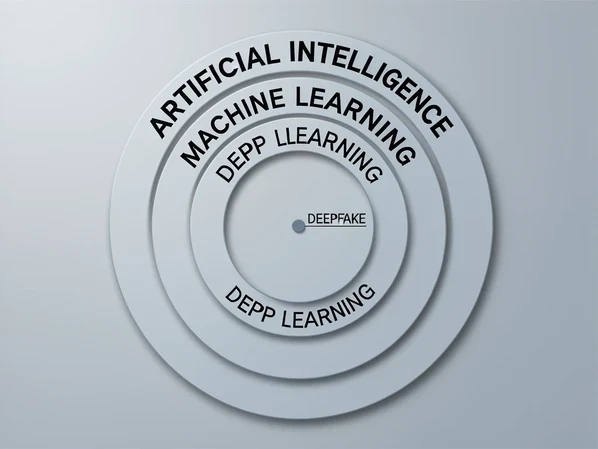
Trace the full chain and the placement is obvious: AI, the field, contains machine learning, which contains deep learning, which powers GANs, which can produce a deepfake of one specific celebrity. Five steps down from the umbrella. That distance is exactly why a deepfake is a subset, not a synonym.
Deepfake vs other AI-generated content
Here is where most people slip. A deepfake imitates a real, identifiable person. General AI art is built from a prompt and need not depict anyone who exists. The technology overlaps; the target does not.
Consider two outputs side by side. A video of a real CEO appearing to announce a fake merger is a deepfake, because it puts words in a real mouth. A text-to-image portrait of an imaginary executive who has no real-world counterpart is AI-generated art, not a deepfake. Nobody is being impersonated, so the deepfake label does not apply.
| Question | Deepfake | Other AI-generated content |
|---|---|---|
| Does it copy a real, named person? | Yes, that is the whole point | No, the subject can be invented |
| Typical goal | Imitate someone, often to mislead | Create an image, voice, or text from a prompt |
| Example | A real actor's face on someone else's body | A portrait of a person who does not exist |
| Needs a face? | Not always, a voice clone qualifies | Depends entirely on the prompt |
Two edge cases catch people out. A voice clone counts as a deepfake even though no face is involved, because it replicates a real person's tone, cadence, and speech patterns. ESET lists voice cloning as a deepfake technique precisely for that reason. Meanwhile an AI-generated image of a person who does not exist is the reverse case: clearly AI, clearly not a deepfake. Face present, but no real identity behind it.
Why the distinction matters
Getting the word wrong distorts how seriously you take a fake. Call all AI output deepfakes and you overstate the risk, treating a harmless prompt-painted landscape as a threat. Call all deepfakes just AI and you understate the danger, waving off a targeted impersonation as routine machine output. The error cuts both ways.
What separates the two is intent. A deepfake carries a deliberate aim to imitate a real person, typically to deceive. Generic AI content does not. The same GAN can paint a fictional face for a game or clone a relative's voice for a scam call. The pixels come from the same place. The purpose is what makes one benign and the other dangerous.
And the abusive slice is growing fast. Proofpoint reports that deepfake files online climbed from roughly 500,000 in 2023 to an estimated 8 million in 2025. U.S. deepfake fraud losses topped $1.1 billion in 2025, more than triple the $360 million lost the year before. This is not a fringe corner of AI.
Up to 96% of deepfakes online are nonconsensual pornography, mostly targeting real people. That single figure, from Fortinet, is why the precise word matters: the harm is concentrated, deliberate, and aimed at identifiable victims.
So the accurate sentence is not "a deepfake is AI." It is "a deepfake is one specific, often harmful application of AI." Keep that distinction and you can judge any given fake on what it actually is, rather than on a label that blurs the most important detail: whether someone real is being impersonated.