
Face Swap Detection: What Actually Works and Where It Breaks
Can Face Swaps Be Detected? The Short Answer
Yes, face swaps can be detected. Not perfectly, though. Detection works, it just is not 100% accurate, and there are documented ways to fool current systems. Reversing a swap to recover the original person behind it sits in a different category entirely: that cannot be done. And human judgment is a weak backup. Only 24% of people manage to spot a deepfake, even though 57% of global consumers believe they can, according to iProov's Threat Intelligence Report.
Hold those three facts before reading further. Detection is probabilistic, reversal is impossible, and your own eyes are unreliable. The rest of this article explains how detectors reach a verdict, where the accuracy numbers come from, and the exact conditions that let a swap slip through.
What Detection Is Actually Looking For: Visual Artifacts and Technical Signals
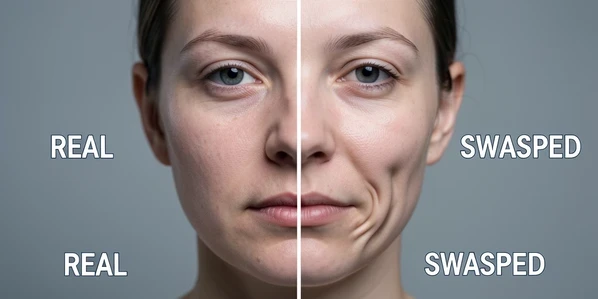
Most face swaps leave traces. Some are visible if you know where to look, others surface only under machine analysis. The give-aways cluster around motion and edges, the places where a synthetic face has to track a real moving head.
- Blinking looks unnatural, or the timing feels slightly off
- Facial warping during a quick head turn
- Lighting on the swapped face that simply does not match the scene behind it
- Detail collapses around the eyes and mouth, the two regions hardest to fake convincingly
Automated detectors go further than the eye can. Rather than matching pixels one to one, modern AI models read the outline and consistency of a face across a frame, which is why a swap that looks clean to a person can still register as manipulated. The catch: older methods built on facial landmarks or pixel-level inconsistency tend to struggle once the source face is seamlessly blended into the target. A system that relies only on visual facial matching may miss the swap completely, because the subtle inconsistencies never rise to the level of a hard pixel error.
How AI Detection Tools Work: From Pixel Analysis to Style Features
The strongest detectors treat a face as a fingerprint of features, not a grid of pixels. In the SafeVision study, a classifier built on an ArcFace embedding layer reached 97.8% accuracy with a 0.97 AUC at separating swapped faces from real ones. Other face-recognition backbones landed close behind.
| Model architecture | Face-swap classification accuracy |
|---|---|
| ArcFace (embedding layer) | 97.8% (0.97 AUC) |
| CosFace (embedding layer) | 97.2% |
| FaceNet (embedding layer) | 97.0% |
| VGGFace2 (Conv 3/4/5) | 96.4% |
| VGG-19 | 94.2% |
| ResNet-101 | 93.8% |
SafeVision itself takes a different route. It detects swaps using style features and, by design, never needs access to the real facial image, which matters for organizations that cannot legally store biometric data. The team tested it against 14 face-swapping techniques, among them FaceSwap, SimSwap, InSwapper, E4S, Facedancer and Roop, then built a final evaluation set of 16,000 image pairs generated from 8 of those techniques. One honest limitation remains: detecting swaps under occlusion or subtle alteration is still insufficiently addressed across current research. The full method and figures are documented in the SafeVision study.
Three Detection Scenarios: Static Images, Injected Streams, and Real-Time Video Calls
Detection difficulty is not one problem but three, and they get harder in order. A static image is the friendliest case, since the detector has a fixed frame to study. A digitally injected video stream is harder. A live video call is the hardest of all.
Digital injection attacks are why. Instead of holding a fake up to a camera, the attacker injects the swapped face straight into the network or application layer, bypassing the camera sensor entirely. That distinction drives an uncomfortable gap in standards. Presentation Attack Detection, where a fake is shown to a camera, is accredited by bodies such as NIST FRVT and iBeta. For digital injection attack detection, no equivalent accredited standard exists, so vendor claims cannot be checked against an independent benchmark.
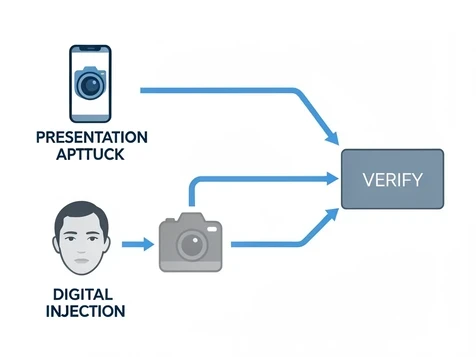
Live calls add another weakness. Active liveness checks ask you to blink, nod or smile, and those motion prompts are exactly what real-time face swap tools are built to perform on cue. Because active systems are targeted so often, passive liveness, which never asks for a predictable action, is the recommended approach. The barrier to entry keeps dropping too. A single frontal face image is now enough to drive some tools, and a few can swap faces inside real-time meetings.
Consumer defenses are starting to appear. HONOR phones ship with a built-in AI Deepfake Detection feature for real-time video calls, reachable under Settings > Security & privacy > Device & data protection > AI Deepfake Detection. Useful, but it guards the person on the call. It does nothing for an organization trying to verify an incoming identity claim.
Commercial Detection Tools: What They Can and Cannot Do
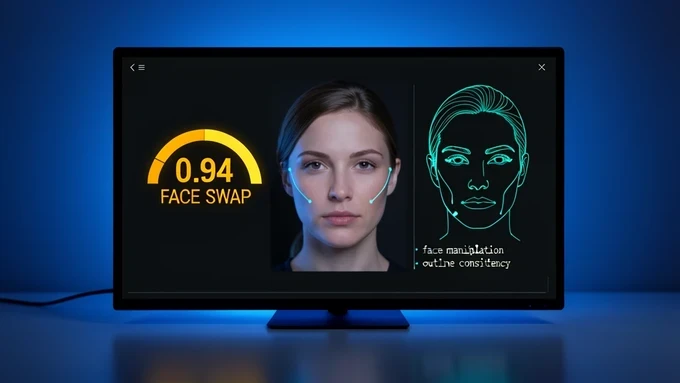
Commercial services exist, and they are candid about their ceiling. Sightengine's deepfake detection processes millions of items per month with near real-time results and is continuously updated as new generators appear. It flags face swaps, face regenerations and other AI-generated modifications by analyzing the outline and consistency of faces, and teams plug it into user onboarding, content moderation or media analysis.
Sightengine's own policy: "Results can be inaccurate. Rely on your own judgment and verify with additional context."
That disclaimer is not boilerplate. Run a swapped portrait through Sightengine and you get a confidence score, say a high probability of manipulation, alongside an outline-consistency reading that marks where the face fails to cohere. A genuine photo returns a low score. A borderline case, a lightly edited swap or an unusual angle, can land in the ambiguous middle. Which is exactly why the vendor tells you to verify with context rather than trust the number alone.
Why Detection Fails: The Arms Race Between Generation and Detection
Detection never stays solved, and the reason is structural. Novel face swap attacks grew 295% from the first half of a year to the second, per iProov, and that pace is fueled by Crime-as-a-Service networks that package and share whatever attack method just worked.
iProov Threat Intelligence Report: "Crime-as-a-Service is growing: the availability of online tools is accelerating the evolution of the threat landscape, enabling criminals to launch advanced attacks faster and at larger scale."
The technical consequence shows up as poor cross-dataset generalization. A model trained on known face-swap techniques scores well on those, then underperforms the moment it meets a generator it has never seen, which is the normal real-world condition. So detectors go stale fast. And with no accredited standard for injection attacks, each organization is left to vet vendors on its own, without a neutral body to confirm the claims.
Can a Face Swap Be Reversed to Identify the Original Person?
No. A face swap cannot be reversed to identify the original person, and the answer from the people who build this software is blunt. Asked directly on the faceswap.dev forum, the admin response was "absolutely not": only detection is feasible, never identity recovery. A detector can confirm that a swap happened. It cannot reconstruct the face underneath or tell you who was behind it. For a fraud victim or a law enforcement investigation that is a hard wall. The manipulation is provable, the perpetrator is not retrievable from the media itself.
Real-World Stakes: What Happens When Detection Fails
In February 2024, Hong Kong police reported a case that shows the cost of a missed swap. Criminals used a deepfake to impersonate a company's CFO during a video conference and walked away with 200 million Hong Kong dollars. The call looked real enough to clear an internal transfer.
Set that against human reliability. With only 24% of people able to spot a deepfake despite 57% believing they can, manual review is a thin line of defense. The same techniques fuel identity fraud, impersonation, non-consensual intimate deepfakes (NCID) and the creation of child sexual abuse material (CSAM). This is why benchmark accuracy, however impressive on paper, is not the whole story.
Common Misconceptions About Face Swap Detection
Four beliefs cause the most trouble.
| Myth | Reality |
|---|---|
| Humans can reliably spot face swaps by eye | Only 24% succeed, and many modern swaps are genuinely indistinguishable to people |
| A face swap can be reversed to reveal the original person | Not possible. A swap can be flagged, never undone |
| Active liveness checks (asking you to blink or nod) stop the attack | Real-time swaps perform those prompted actions on demand, which is why passive liveness is the safer choice |
| Viral face swap demos show what detectors really face | Demos use curated inputs and post-editing, while real footage is messier and far more varied |